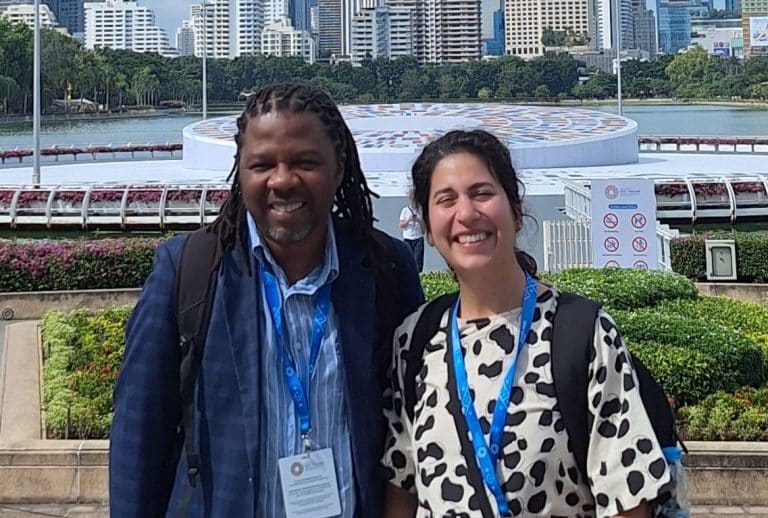
Last week, I was in Bangkok on behalf of Wemos for the IMF and World Bank Group Annual Meetings with our partner N’weti, from Mozambique, with whom we advocate for a fairer global financial architecture and strong health systems. Together with our civil society networks and allies, we challenged the continued focus on private capital mobilization, fiscal consolidation and austerity, and pushed for policies that put people’s health, rights and public services before creditors and private profit.
Inside the annual meetings
Inside the conference centre, the mood on stage was upbeat, and official sessions at times felt like a sales pitch for the World Bank’s latest agenda. But the conversations in the corridors and at the Civil Society Policy Forum sessions told a far more worrisome story.
Unfortunately, the old storytelling has not changed. Ajay Banga (President of the World Bank Group) and Kristalina Georgieva (Managing Director of the IMF) pitched private capital mobilization and AI investment as the silver bullet for growth, with an enthusiasm that seemed unmatched with the reality of countries hit by repeated global shocks.
Little was said about who pays the bill for such investments: low- and middle-income countries are already borrowing at higher rates and carrying heavier debt loads. Nor was there much reflection on the risk that today’s AI rush could end in a possible sustainability crash. The technology’s need for critical minerals, energy, water and finance keeps growing, and so do its emissions and its pressure on workers’ rights. For resource-rich countries, this looks worryingly like a new version of extractivism, with the profits made elsewhere and local communities left to deal with the damage.
Meanwhile, the IMF’s prescription is still the same: fiscal consolidation, austerity and privatization. It sticks to this despite the alternatives for expanding fiscal space that civil society keeps putting forward at every opportunity – alternatives such as increase progressive tax revenues, fighting illicit financial flows, and restructuring or eliminating debt. It also sticks to this failed recipe despite decades of evidence of the harm done, with women bearing the heaviest share when public services and care are cut.
Against this backdrop, Banga’s repeated framing of poverty as “a state of mind and a state of being”, entirely leaves aside its structural causes.
At the Debate on the Global Economy, Greece was even celebrated for having learned its lesson on fiscal discipline, with no word about what austerity cost its people. In civil society spaces, that cost was openly discussed, confirmed and challenged.
Even if the IMF often deflects such criticism by insisting it has no human rights mandate, what I learned at the Feminist Festival is that the IMF is a UN specialized agency, part of a system founded on the UN Charter. In addition, its member states all have human rights obligations that don’t disappear when they sit around the Fund’s table.
Engaging with policy reviews
A key moment in our participation as a Dutch CSO was the engagement with the European Executive Directors at both institutions on the Review of Programme Design and Conditionality, the Comprehensive Surveillance Review and the LIC Debt Sustainability Framework review. Together with our networks of civil society, we discussed and challenged them regarding both the process and the content of these policy reviews.
At the World Bank Group roundtable with CSOs, I asked how the Board will ensure the new International Finance Corporation (IFC) Sustainability Framework does not regress, in risk assessment and in clients’ implementation and compliance, especially in social-sector projects such as health. The answer was a transition rather than a gap, and a commitment to non-regression. Those are welcome words, and now we will keep watching how they hold up in practice.
Another powerful moment for me was witnessing Indigenous Peoples’ organizations representatives sharing their collectively developed minimum demands for the safeguards review of the IFC and Multilateral Investment Guarantee Agency (MIGA).
Making space for different voices
Besides the official meetings and the Civil Society Policy Forum, I joined two off-site side events: the International People’s Assembly, convened by 200 CSOs, trade unions, and debt and climate justice coalitions from across Asia, Africa, and Latin America, and MenaFem’s Feminist Festival of Resistance and Alternatives.
Moving between these two worlds was refreshing. Outside the official halls, the International Financial Institution’s language no longer sets the terms of the conversation. It was energizing to be surrounded by activists and grassroots organizations who aren’t asking for small reforms of the system but for real change: taxing the rich, ending austerity, pushing back against debt “solutions” that put creditors before people, and fighting for climate justice.
These spaces also made room for voices the official process left out. The Civil Society Policy Forum did not accept a single session proposal from Indigenous Peoples’ organizations, yet at the off-site events they had plenty of space, and we had the chance to listen to their valuable contributions and lived experiences. It was a powerful reminder of who our advocacy is ultimately for.
Continued advocacy
Our advocacy towards the World Bank and the IMF doesn’t stop when the Annual Meetings end. Together with N’weti and our civil society networks and allies, we will follow up on the conversations we started in Bangkok. That includes the ongoing reviews of conditionality, surveillance and debt sustainability, and the promise of non-regression in the IFC Sustainability Framework.
We’ll keep pushing for policies that put people’s health, rights and public services before creditors and private profit.