Inequalities in budget allocation for social sectors in Mozambique
13/4/2026
- Report
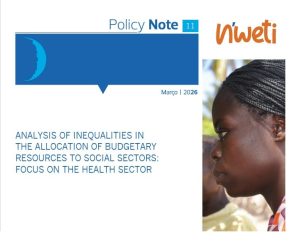
With our partner N’weti, we work to strengthen health financing in Mozambique. N’weti leads the analysis of the country’s situation, with our support as needed, while together we focus on how global policies and actors influence the financing of Mozambique’s health system. Recently, N’weti published a policy note examining inequalities in the allocation of public resources to social sectors, with a particular emphasis on health, that also provides recommendations for improvements.
Mozambique’s social sectors are currently grappling with a decline in external funding alongside a broader fiscal crisis. Although health is officially recognized as a priority sector, N’weti’s analysis reveals that it consistently receives less funding than education. Between 2015 and 2024, health spending accounted for only 9.6% of total public expenditure, far below the 15% Abuja Declaration target, while education received 17.7% on average. The policy note also highlights weaker budget execution in health, with an average execution rate of 84%, compared to 95% in education, dropping to just 71% in 2024.
A political economy perspective
What distinguishes this policy note is its political economy approach. Rather than viewing budgets as purely technical documents, it explores the social, economic, and political dynamics shaping the budget process. This perspective acknowledges that budgeting is influenced by power dynamics and class struggles, and not merely by neutral administrative decisions. This analysis draws on Marxist political economy and theories of the capitalist state to explain how these dynamics affect public resource allocation.
The significant impact of debt
The report underscores the significant impact of public debt on Mozambique’s fiscal space. In both 2024 and 2023, debt service payments exceeded public spending on health. This persistent underfunding of health reflects broader political and economic priorities that shape how public resources are allocated and limit investments in social sectors.
Geographical inequalities
Inequalities in Mozambique are not only between sectors, but also geographic. The report finds a strong concentration of medicines and investment spending at the central level, with uneven distribution of operating expenses across provinces and districts, deepening territorial disparities.
Recommendations for change
To address these challenges, the policy note recommends:
Reversing the decline in health financing by increasing the state budget share for health to meet or exceed the Abuja target of 15%.
Involving a broader range of health sector stakeholders in setting budget priorities.
Incorporating local social dynamics into allocation decisions to ensure more equitable distribution.
Tackling structural economic issues that cause recurrent budget crises, rather than relying on austerity measures that disproportionately harm social sectors.
Striking a better balance between macroeconomic fiscal constraints and the fulfillment of basic social needs.
Collaboration for equitable health financing in Mozambique
Together with N’weti, we examine how global policies and actors affect Mozambique’s health financing, including the heavy burden of debt servicing on the government’s capacity to invest. Our current work focuses on analysing International Monetary Fund (IMF) global policies and loan programmes in Mozambique. Based on this, we develop recommendations for equitable health financing and engage with the IMF, World Bank, and other stakeholders both in Mozambique and globally.