Civil society calls for a fairer debt sustainability framework
19/5/2026
- Event
In our project with N’weti, we influence policies and institutions that shape Mozambique’s fiscal space for health. One aspect we look at is the review of the IMF/World Bank Debt Sustainability Framework for Low-Income Countries (LIC-DSF), a tool that guides the borrowing decisions of low-income countries. During the Civil Society Policy Forum of the IMF and the World Bank Group Spring Meetings in April, Wemos and N’weti joined a discussion on the future of this framework, that emphasized the importance to consider social impacts of austerity, societal buy-in and a focus on development and human rights.
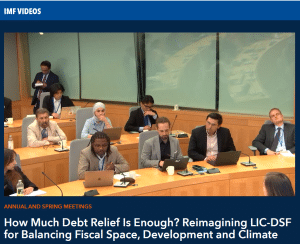
Together with N’weti, we attended the Civil Society Policy Forum of the IMF and the World Bank Group Spring Meetings in April. We joined an interesting session on the future of the LIC-DSF, titled “How much debt relief is enough? Reimagining LIC-DSF for balancing fiscal space, development and climate”. Since this framework influences how debt risks are assessed, how much countries can borrow, and which conditions are attached to financing and debt restructuring, it is an important instrument that impacts Mozambique’s and other countries’ fiscal space for health. You can watch the recording here.
“Gatekeeper” for poverty reduction
In this session, speakers from civil society and academia stressed that debt sustainability cannot be reduced to whether creditors are repaid. Notably, Dr Bertha Bangara Chikadza from the University of Malawi Economics Department argued that the LIC-DSF framework acts as a “gatekeeper” for poverty reduction, because it influences access to finance, debt relief, and the fiscal space available for health, education, social protection and development. She also warned that debt sustainability analyses may appear technical, but are, in fact, deeply shaped by political choices, data limitations, forecast assumptions and staff judgement. This creates risks of bias and inconsistency, especially when debtor countries’ own knowledge, priorities and political realities are not sufficiently reflected.
Sustainability and austerity
Anahí Wiedenbrüg from the International Institute for Sustainable Development (IISD) highlighted methodological weaknesses of the framework, including the need to distinguish more clearly between fiscal/public debt sustainability and external sustainability. Didier Jacobs from Oxfam International warned that the current framework does not adequately protect countries against excessive austerity or safeguard social spending. He argued that societies cannot be expected to “stomach” unlimited austerity, and that the alternative of deeper debt restructuring is too often overlooked.
Addressing the social impacts of austerity
A key intervention from the floor came from our partner Andes Chivangue from N’weti, who linked the discussion directly to Mozambique’s current reality. He noted that IMF Article IV recommendations for expenditure-based fiscal consolidation have translated into measures such as the elimination of the 13th salary, salary freezes, blocked career progression, and restrictions on social sector spending. He also raised concerns about Mozambique’s recent debt repayments, the negotiation of a new Extended Credit Facility (ECF) lending programme, and the social unrest around the election period. His question challenged the IMF/World Bank to explain how the revised LIC-DSF will mitigate the social impacts of austerity. The IMF representative could not answer on a specific country case, but expressed the hope that the new LIC-DSF will better calibrate the new ECF negotiations.
The need for societal buy-in
The discussion also raised the issue of political feasibility and societal buy-in. The IMF/World Bank representatives noted that the revised framework may include indicators related to the fiscal effort required for adjustment, which could help assess whether proposed policies are realistic. Civil society speakers emphasized that this cannot remain a closed technical process: debt sustainability assessments and programme negotiations need transparency, timely publication, parliamentary scrutiny and engagement with civil society. Without public debate and societal buy-in, programmes risk being presented as a fait accompli – and are more likely to fail in practice.
The session made clear that reforming the LIC-DSF is not merely a technical exercise. It is about who defines sustainability, whether debtor countries and civil society have a meaningful voice, and whether debt analysis supports development and human rights rather than locking countries into repeated cycles of austerity and debt distress.
Equitable health financing for a strong health system in Mozambique
In this project, N’weti and Wemos are working together to strengthen Mozambique’s public health system, ensuring equitable and accessible healthcare for all. Through community-level data collection, fiscal space and policy analysis, awareness-raising, and lobby and advocacy activities, we aim to support a sustainable and equitable National Health Financing Strategy and increase national and international resources to Mozambique’s public health system. Alongside national advocacy, the project includes a global-level advocacy component aimed at influencing policies and institutions that shape Mozambique’s fiscal space for health.